
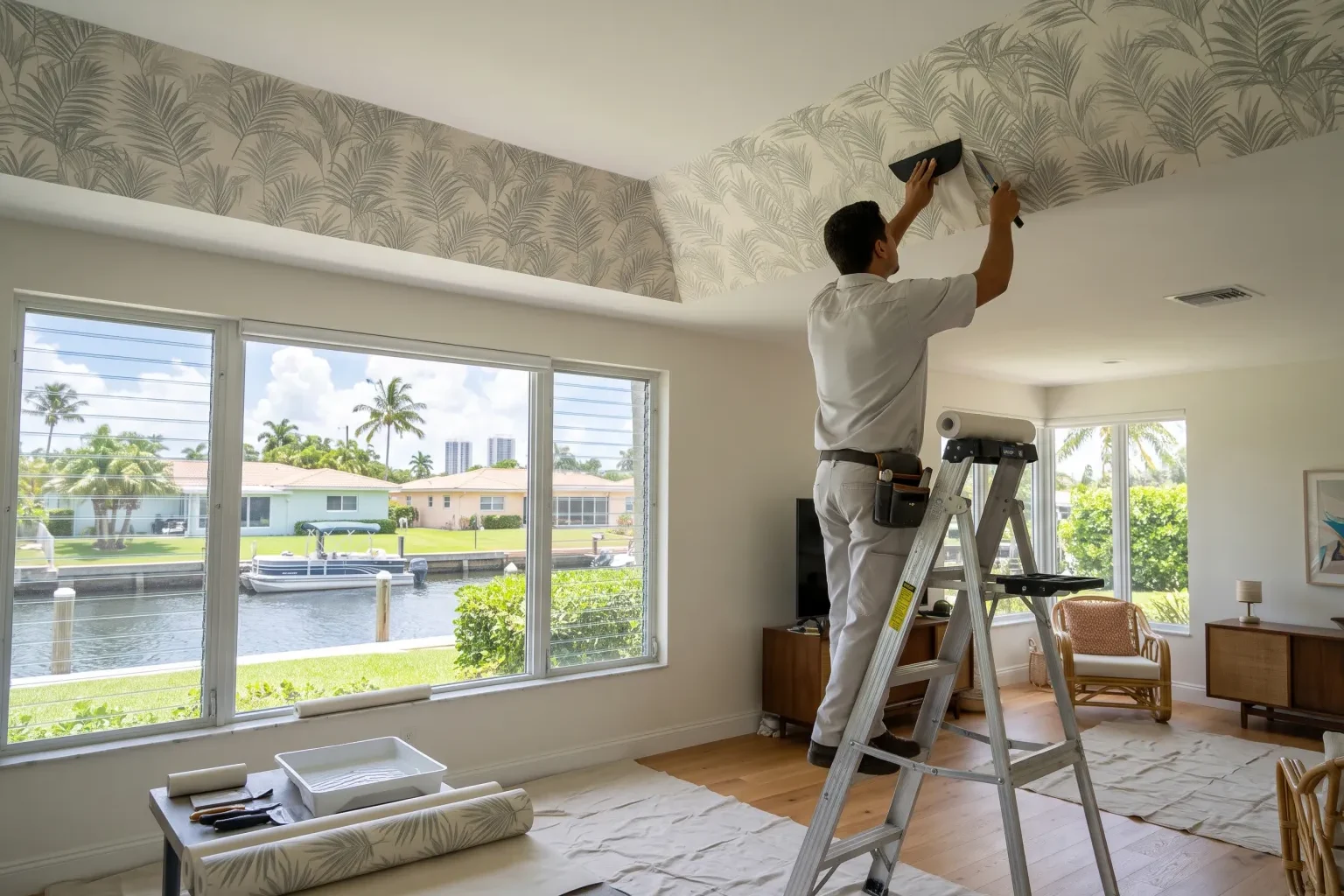
The short answer
Ceiling wallpaper turns the overhead surface into a design feature, and it works best in dining rooms, bedrooms, powder rooms and covered porches with flat or tray ceilings. We repair and prime the drywall, plan strip direction and pattern placement, then hang lightweight-friendly paper with strong adhesive and careful trimming at walls and fixtures.
Ceilings are the largest blank surface in most rooms, and they are almost always ignored. Papering one, sometimes called a fifth wall, draws the eye upward, makes a low room feel cozier and intentional, and gives a tall room a finished top. It is also harder work than hanging paper on a vertical wall: gravity pulls on every wet strip, the installer spends hours overhead, and light from windows rakes across the surface and exposes every ripple. True Wallpaper Installation papers ceilings in Fort Lauderdale and nearby Broward communities, from small powder rooms to dining rooms and primary bedrooms. Here is how we approach it.
Rooms where a papered ceiling pays off
A ceiling treatment suits rooms where people sit or lie down and naturally look up. Dining rooms are a classic choice, especially with a chandelier centered in the pattern. Bedrooms, nurseries and reading nooks benefit from a soft, quiet print overhead. Powder rooms are a favorite because the space is small enough to go bold without much material, and the ceiling is often the only surface not taken up by a mirror, vanity or tile.
Tray and coffered ceilings, common in newer homes out west in Weston, Parkland and Coral Springs, make natural frames: papering only the recessed center panel creates a clear border without any trim work. Flat ceilings in older ranch homes nearer the coast can be papered edge to edge.
We are more cautious in full bathrooms with showers and in kitchens over the range, where steam and grease rise straight to the ceiling. Those can still work with a vinyl product and strong ventilation, but we will talk through the risks first.
Getting the ceiling ready
Many South Florida ceilings carry a popcorn or knockdown texture. Paper cannot bond to that reliably, so the texture has to come down or be skimmed smooth. If a house was built before the 1980s, popcorn texture should be tested for asbestos before anyone scrapes it; we will flag this so you can arrange testing before we proceed.
After the surface is smooth, we fill cracks along drywall seams, set any popped screws and sand. Then we roll on a wallpaper primer that seals the drywall and gives the adhesive something consistent to grab. We also look for stains, which on a ceiling usually point to a roof leak, an AC condensate line or a bathroom upstairs. A stain that is still damp means the source needs fixing first. Paper laid over active moisture will sag, especially in our long rainy season from May into October.
- Remove or skim coat popcorn and knockdown texture
- Repair drywall cracks, seams and fastener pops
- Check stains for active leaks before covering
- Apply a primer matched to the paper and adhesive
Our process overhead
Ceiling installation follows the same principles as walls but with more planning, because mistakes are harder to fix while standing on a platform with your arms raised.
- Measure the ceiling and decide strip direction. We normally run strips across the shorter dimension so each piece is easier to handle, unless the pattern has a clear direction that looks better another way.
- Choose the focal point. In a dining room this is the light fixture; we center a motif or seam on it so the pattern looks deliberate from the table.
- Mark a straight reference line across the ceiling, since walls are rarely square to one another and following one would skew the whole layout.
- Cut strips with extra length for trimming where the ceiling meets the walls, and keep the pattern matched from strip to strip.
- Paste and book each strip, then fold it accordion-style so it can be carried up and unfolded section by section against the ceiling.
- Smooth from the center line outward with a brush, butt seams tight and roll them lightly so they stay down as the adhesive cures.
- Trim along wall lines, crown molding and around fixture boxes. Light fixtures and fans are removed or loosened beforehand so the paper fits behind their canopies.
Factors that drive the price
Ceilings take more labor per square foot than walls, so the estimate depends heavily on the specifics. Texture removal is often the biggest variable: a smooth ceiling needs only light prep, while a popcorn ceiling needs scraping or skim coating and drying time before any paper goes up.
The paper itself matters too. Lightweight, flexible papers are easier overhead than heavy or stiff ones, and grasscloth or delicate printed papers demand slow, careful handling. A large pattern repeat creates more waste and more alignment work. Finally, room size and height play a role. A standard flat ceiling can be reached with ladders and planks, while vaulted or two-story ceilings call for scaffolding and more set-up time. Cutting around multiple recessed lights, fans or skylights adds steps as well.
Caring for a papered ceiling
A ceiling gets touched far less than a wall, so day-to-day care is light. Dust it occasionally with a long-handled soft duster or a vacuum brush on low suction. Wipe only if the material is rated washable, and even then use a barely damp sponge.
Moisture is what really matters. Run bathroom exhaust fans during and after showers, and keep the AC on through the humid months so the room does not swing between damp and dry. After a big storm, glance up for any new stain; catching a roof or AC leak early protects both the paper and the drywall behind it. If a seam starts to lift, contact us soon so it can be re-adhered before it spreads.